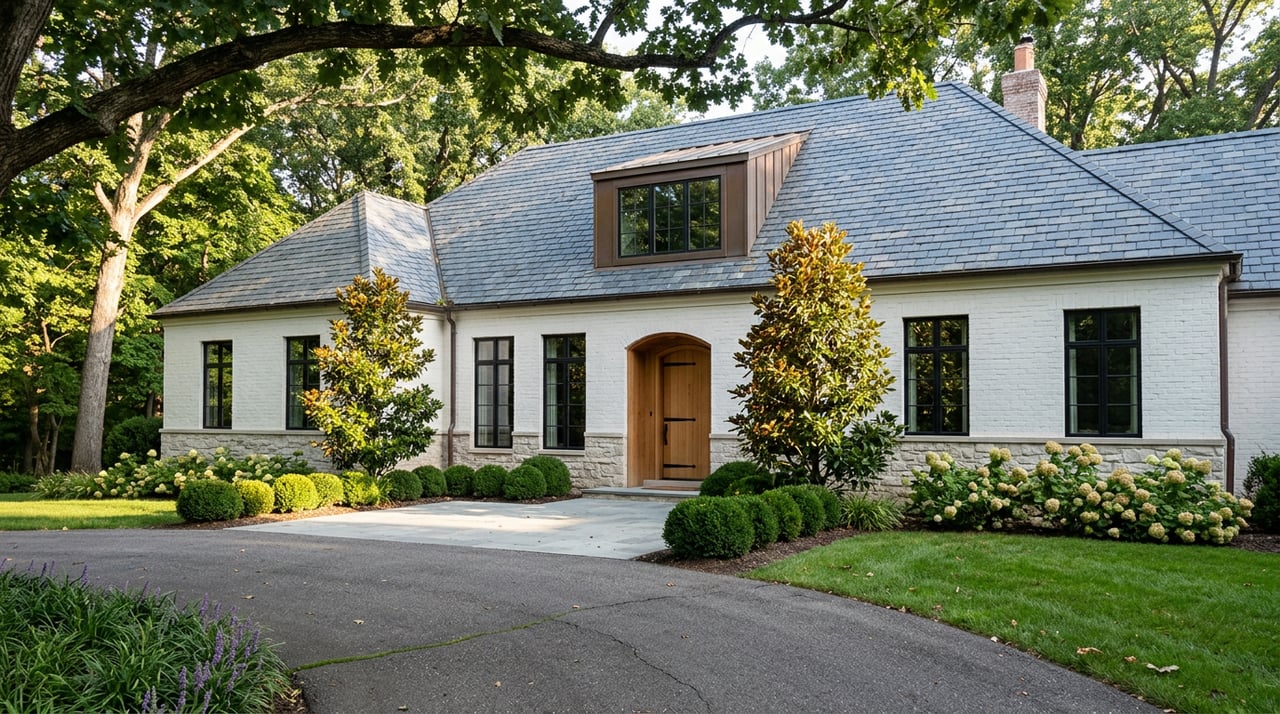
Oak Hill's median sale price rose 8.8% over the year ending May 2026, and the average home took 95 days to sell instead of last year's 73. Prices climbing while turnover slows is not the pattern you get in a normal upper-tier market. It is the pattern you get when the housing stock cannot grow.
Most Nashville luxury enclaves have some pressure release. Belle Meade has occasional teardown-and-rebuild activity along its trophy corridors. Brentwood has continued to add gated communities. Green Hills has quietly absorbed mid-rise condo product along Hillsboro Pike. Oak Hill has none of that. The city's charter forecloses it.
That is the thesis of this piece: when a buyer pays the Oak Hill median, they are not just buying a house. They are buying a position inside a legally capped supply, and the capital they will spend later, on renovation or new construction, is repriced by rules most buyers do not read until they are already under contract.
The supply cap is written into the charter
Oak Hill is an incorporated satellite city, not a Nashville neighborhood. It was chartered in 1952, before the Metropolitan Government of Nashville and Davidson County existed, and it has kept its own commissioners, planning commission, board of zoning appeals, and codes department ever since. The city describes itself as roughly 8 square miles containing about 1,800 homes and 4,700 residents, all inside "exclusive single-family zoning."
"Exclusive" is the operative word. Per the city's own variance procedures, Oak Hill is zoned strictly residential, with churches and schools allowed only through Conditional Use Permits and no businesses or non-profits inside city limits. Churches and schools that do apply must sit on a minimum of 6.42 acres. The Tennessee Governor's Residence is inside city limits. That is roughly as close to a commercial address as Oak Hill contains.
For a buyer, the practical translation is short. There are about 1,800 possible houses to own here, and that number does not go up meaningfully in any given year.
Six zones, one rulebook
The city divides its ground into six residential districts, labeled A through F, all restricted to single-family dwellings. Minimum lot sizes range from 10,000 square feet at the tighter end to 4 acres at the estate end, with setbacks, lot coverage caps, and height zones that shift district by district.
Element | How Oak Hill handles it |
|---|---|
Districts | Six residential zones, A through F, single-family only |
Minimum lot size | 10,000 sq ft on the small end, up to 4 acres on the estate end |
Non-residential uses | Churches and schools only, Conditional Use Permit required, 6.42 acre minimum |
Multifamily | Not permitted in any district |
Homes per lot | One single-family dwelling per lot |
Governing body | City of Oak Hill Planning Commission, Board of Zoning Appeals, Codes Department |
Compare that to the Metro Nashville zoning menu, where R and RS districts scale down to 3,750 square foot single-family lots and RM districts allow up to 100 units per acre. Oak Hill's floor sits above Metro's ceiling for low-density product. That gap is why lot value inside city limits behaves differently than it does one block outside.
What the May 2026 numbers are actually saying
Over the three months ending May 2026, the Oak Hill median sale price was $2.4M, up 8.8% year over year, at $509 per square foot, up 7.0%. Twenty-nine homes closed in May, up from 20 in May 2025. Days on market moved from 73 to 95.
Read those together. Volume ticked up modestly. Price rose materially. Time to sale lengthened. In a normal market, rising DOM softens price. Here, it did not, because the pool of buyers willing to accept Oak Hill's specific package, acreage, mature canopy, and single-family-only surroundings, has effectively no substitute product to shop against. When a buyer decides they want Oak Hill, they wait for the right listing rather than pivot.
As of mid-May 2026, active inventory sat at roughly two dozen homes with an average list price near $4M, ranging from about $1.25M to just under $10M. That is a thin book against 1,800 total homes, which is why the market can look quiet in raw counts and still print higher clearance prices.
The renovation math changes here
This is where buyers get surprised, and it is the part portals cannot tell you.
Because Oak Hill's supply is capped, most Oak Hill purchases are eventually renovation projects. And renovation is where the city's rulebook meets the buyer's checkbook.
Per the city's own variance procedures, variances "are granted on the basis of hardship, i.e., hills, slopes, easements, large trees, existing construction, etc., not inconvenience," and any granted variance "will be the minimum variance possible for the proposed structure."
Read that twice if you are planning to expand a footprint. Oak Hill's Board of Zoning Appeals is not asked whether your addition would be attractive, or whether the neighbors support it. It is asked whether a physical condition of the land makes strict compliance genuinely impossible. If your reason is that you want a bigger kitchen, that is inconvenience, and it will not clear the standard.
The layered rules do not stop at setbacks. Ordinance 2023-04 codifies a Radnor Lake Natural Area Impact Zone and requires special review for construction touching slopes of 15 percent or greater with an area of 1,000 square feet or more. The city's residential infill submission checklist sorts new work into Tier I, II, or III depending on added impervious area, with Tier III triggered at 8,000 to 15,000 square feet of net added impervious surface. Tree protection standards regulate trenching inside driplines. Retaining walls of 4 feet or more require engineered design. Front setbacks are the more restrictive of the tabular or contextual setback, meaning the neighbors' setbacks may pull yours farther from the street than the code table alone suggests.
For a buyer running renovation math, the practical costs are architect time to solve for the site rather than the wish list, stormwater engineering on any meaningful expansion, arborist coordination for foundation and utility work near mature hardwoods, and a longer entitlement clock than a comparable Brentwood or Green Hills project. That is not a warning. It is the price of buying inside the cap.
Where the money is landing
Trophy pockets remain concentrated. Lealand Manor is widely regarded as the most exclusive enclave, with averages reported above $5 million. Villa Estates carries bluff-lot properties with long views. Oak Hill Estates and Creighton Meadows anchor the established, tree-canopied streets, while Inns of Granny White sits near the Granny White Pike corridor.
Corridors doing the most work in current transactions include Battery Lane, Overton Lea Road, General Gates Drive, Franklin Pike, Lealand Lane, and Blevins Drive. Recent listings on Battery Lane and Churchwood illustrate the current build pattern: gated one-acre modern estates in the seven to ten thousand square foot range, often designed by studios like P. Shea Design and executed by builders including McKenzie Construction and Craftsman Residential. The city's design and construction standards mean these are typically slower, more scrutinized projects than speculative builds in less regulated pockets of Metro.
How Oak Hill prices against its neighbors
Buyers weighing Oak Hill against Forest Hills, Brentwood, or Belle Meade often frame the choice around price per acre or price per square foot. The mechanism to weigh instead is optionality.
- Belle Meade protects architectural continuity through its Historic Zoning Commission, but its lot pattern allows more discretionary rebuild activity along the trophy streets.
- Forest Hills shares Oak Hill's estate-lot character and steep-slope topography, and it too has strict residential zoning, though its supply constraints and lot mix differ.
- Brentwood offers scale, newer construction, and Williamson County schools, with far more elasticity in the housing stock.
- Oak Hill offers proximity to Green Hills, 12 South, and downtown that Brentwood cannot, plus Radnor Lake State Park's 1,368 protected acres and 7.75 miles of trail inside daily driving orbit, at the cost of a rulebook that limits what you can build after you close.
If your five-year plan involves a significant footprint expansion, Oak Hill's math tightens. If your plan is to buy a well-sited existing home and enjoy the trees, it loosens considerably.
A short FAQ
Can I subdivide an Oak Hill lot to build a second home for a family member? Subdivisions and recombinations are reviewed by the Planning Commission on a case-by-case basis, and applicants must meet the minimum lot area for their zoning district, which ranges from 10,000 square feet to 4 acres. A resulting lot that does not meet the district's minimum is not a matter of appeal, it is a matter of code.
Does a variance denial kill my project? Not necessarily, but a redesign that avoids the variance is usually faster than a second application. The hardship standard is genuinely narrow, and the Board of Zoning Appeals is required to grant the smallest variance possible when it does grant one.
Does Oak Hill have an HOA? Some subdivisions have covenants, but Oak Hill itself is a municipal government, not an HOA. The rules that constrain construction are municipal ordinances enforced by the Codes Department, which is a stronger and more permanent form of oversight than any homeowner's association.
Should I expect competition on the best listings? Active inventory has been thin. With roughly two dozen homes on the market against a total housing stock near 1,800, well-priced listings in the core corridors have historically drawn interest quickly, even as broader DOM has lengthened.
If you are weighing an Oak Hill purchase against Forest Hills, Brentwood, or Belle Meade, the right conversation is not about price per foot. It is about which rulebook you want to own inside, and how that rulebook will price the next decade of your plans for the property. Nashville Luxury Homes works with buyers and sellers across all four markets and can model the specific renovation, variance, and resale scenarios for any address you are considering.
Get Your Home Featured.